|
Swallows & Amazons Down under Tea Bay Polly Unmasked! Latitude and Longitude Natives Peter Duck Pirate gold Pelorus Jack Swallowdale Pirate gold Already loaded Howdy Polly Unmasked! Which foot, Roger? The missing stretcher-bearer Winter Holiday |
Coot Club AR Not a Railway Buff Three million cheers Dick's Fancy Dress Pigeon Post Howdy Forgetful Dick We Didn't Mean To Go To Sea A prototype Bond? Secret Water The Sundial Those Vanishing Sandwiches Mangoes or Mangroves? Where's that Dinghy? Where's the totem? Did he really make that? A good sense of direction |
The Big Six Missee Lee Captain Flint's SOS Mangoes or Mangroves? Come off it, Peggy! The Picts & The Martyrs Only on the dust jacket Nancy or Ruth? Forgetful Dick Great Northern? Who's the figure? Which way's the sun? Captain Flint's Amnesia |
|
|
|
In the subsequent discussion two explanations emerged:
Well, there you have it: you pays your money and you takes your choice, as Peter Duck himself might well have said.
So much for Old Sailors' Tales!
Writing from South Africa, Russell Barnes draws attention to the picture 'Loading Captain Flint' on page 177 of
Swallowdale, which shows Roger and Titty (or is it Susan?) heaving a large load onto Captain Flint's back, while Nancy, hand on hip, stands bossily in the background. However a close reading of page 170 shows that Captain Flint was already loaded up when Nancy arrived on the scene . . .
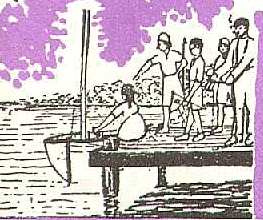
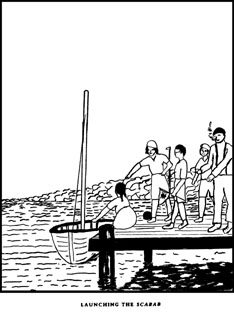
On the dust jacket of The Picts and the Martyrs there is a thumbnail version of a drawing which does not appear in the book. Evidently prepared to illustrate chapter 15, it shows Dick and Dorothea taking delivery of Scarab, with the boat builder looking on and Nancy being masterful. On the right is Dan Ford's 'reconstruction' of the original illustration on the basis of the thumbnail.
Simon Dakin reminds us of one of Ransome's best-known blunders: a brownie patrol spotted that Captain Flint's SOS message in semaphore hidden among the birdseed in Missee Lee contained eight mistakes that had to be corrected in later editions. "Fry, frizzle and broil that fellow Flint. What's the use of my taking trouble when he lets me down like this?" wrote AR in a letter to his publisher (see Christina Hardyment, Arthur Ransome and Captain Flint's Trunk, p. 176).
Illustrating Arthur Ransome mentions that its first illustration in Secret Water shows a Sundial that would have worked only in the Southern Hemisphere. Later editions brought it into the Northern Hemisphere. (Thanks to Simon Dakin).
John Wilson pointed out on Tarboard that in The Picts and the Martyrs chapter 18, Nancy complains about the dreaded Great Aunt, who says while she is practising the piano:
"Please Nancy, these two bars again ..... Nancy ..... Nancy ....."
But the GA always calls Nancy & Peggy by their real names Ruth & Margaret. Wayne Hammond confirms that this was a slip up on AR's part, who corrected his personal copy of PM, now in Abbot Hall: by the 5th printing (1946) this was corrected in published copies also.
Occasionally AR invents a location and then appears to forget about it. Writing from New Zealand, Steve points out that in Chapter 10 of Swallows and Amazons the Amazons stop to have their breakfast (with tea!) at Tea Bay. which is neither marked on the map nor mentioned in any of the other books. However, it does appear on Mike Field's Map of The Lake, in what Mike believes is the definitive location.
Robert Thompson has pointed out that in the 1st edition of Great Northern? the illustration Dick goes off to the lochs shows a figure in the left foreground that is clearly an Amazon pirate, though she seems to be too small to be Nancy. As both of the Amazons were at the time helping to scrub the Sea Bear, the figure should have been Dorothea.
The illustration was corrected in subseqent editions, but as Robert points out, the earlier, incorrect, version is still used on the dust-wrapper of Great Northern?
In a message on Tarboard, Leah Mickens pointed out that in Swallowdale Peter Duck is said to have come back from the Carribees 'with his pockets full of pirate gold.' However, in Peter Duck itself the expedition's booty is no more than a few bags of not-very-valuable pearls. How can this discrepancy be explained?
Writing from Christchurch, New Zealand, Brad Henry quotes from the second paragraph of Chapter XVII of Peter Duck:
... Peter Duck's yarns ... about Pelorus Jack, the fish
that used to pilot vessels into Sydney harbour, and had
a law made in his own protection.
Brad suggests that AR would have known the correct story but points out that Peter Duck had a couple of things wrong:
In a posting on Tarboard Ed. Kiser quoted the following passage from Swallowdale:
Nobody wanted to stay, and besides there were still the things
to fetch up from Horseshoe Cove. Susan got out a bit of paper
from Titty's box and Nancy wrote on it in big letters, "STOP
HERE TILL WE COME BACK."
and queried the use of the 'American' expression 'Howdy' in this context. There is, however, a second occurrence of 'Howdy' in Ransome which suggests a possible solution . In Pigeon Post chapter 28, Nancy is talking about Captain Flint:
"Where shall I put it so that they'll be sure to see it?"
"On the parrot's cage," said John. "Titty always says `Howdy'
to him, even if she's only been away ten minutes."
Susan's hopes suddenly fell again. It was very unlike Titty to
leave the parrot a moment longer than she could help.
"He may be back now. He may be just strolling up here today to say howdy and us without an ingot to show him."
It is not at all surprising that James Turner, prospector and rolling stone, should have picked up the expression 'Howdy' in the course of his travels (in the Klondyke, perhaps, or in the dives of Valparaiso), nor that his niece should associate it with him. In that case, he might well have been in the habit of saying 'Howdy' to his parrot, particularly so if its previous owner had been an American, and it would have been natural for clever, sensitive Titty to continue to greet the parrot in a way that it would recognise.
In Secret Water, Susan refers to the sandwiches she has in her knapsack before the Walkers set off across the Red Sea with the rudder that is to be repaired. However, a mere page later we read that 'Susan had an empty knapsack on her back'. What had happened to the sandwiches? No time to eat them, and surely neither Susan nor Roger would have allowed then to be jettisoned as ballast ...
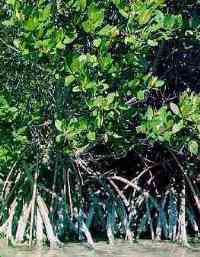
In Chapter VI of Missee Lee John comments "Mangoes. Pretty nearly awash" when he reaches the 'queer huge-leaved trees' with their roots in the water that fringe the Chinese coast. In a contribution to Tarboard Robert Dilley observes that this confuses the mango fruit (commonplace in today's supermarkets but an exotic rarity in the 1930's and 40's) with the mangrove tree (Rhodophora) which is typically found in shallow estuaries on tropical and sub-tropical coasts.
In the discussion that followed it was suggested that the mistake was not AR's but John's, for whom both mangoes and mangroves would have been equally unfamiliar. That view could be challenged: AR tried to be accurate over the factual information he gave, and if this is a 'deliberate mistake' one wonders why it was not later corrected in the same book.More significantly, Missee Lee was not the first place in which it had been made. In Secret Water the low marshy islands to the west of Mastodon Island are named (by Titty) the Mango Islands as they are "All swamp. Nowhere to land."
In Chapter XIII of Missee Lee, the children own up to desecrating the island temple built in memory of Missee Lee's father. John apologises for sleeping in the temple, Susan for using the kettle and the Primus, and Titty for the husks that Polly left on the floor. The most surprising apology comes from Peggy: "We took some of your tea, too," she says. However, when the Walkers were on the island, the Amazons were far away on the Chinese pirate ship. Had Peggy already forgotten? Or was it AR who had forgotten? (Spotted by David Towne).
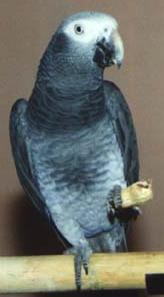
Sandy Valinis, who with her husband has 7 parrots at home, has been casting an expert eye over Polly, and points out that he is not all he appears to be. Swallows and Amazons and Swallowdale describe Polly as having green feathers, which since he is short-tailed means that he is probably one of the Amazon parrots native to Central and South America. However, Sandy points out that the illustration of him in Swallowdale is undoubtedly of an African Grey parrot (see picture right). She writes:
Amazons are stockier in build, have shorter necks and have no featherless patch around their eyes. Also, the rather long and drooping upper mandible and largish cere (the skin surrounding the nostrils) indicate that the illustrator used an African grey as a model.
In other respects, however, AR passes muster: for example like most parrots Polly uses his left foot to grasp objects.
Further mystery accumulates around the illustration 'Stretcher Party' in Swallowdale. Not only are there not enough stretcher-bearers (see below), but it appears that Roger has the wrong foot bound up. In the text we are told that his left foot gets twisted, and towards the end of the book in 'The Charge' it is clearly his left foot that has the bracken poultice. However, in 'Stretcher Party' it is his right foot that has the poultice. (Spotted by Sandy Valinis)
Rachel Klapman points out that in Coot Club the D's went to Norfolk because "it was no good going north at Easter, for the Blacketts were away with their uncle, and the Walkers were in the south with their father, who was home in England on leave." However, by the late summer of that year in We Didn't Mean to Go to Sea we learn that Commander Walker was returning home from a long posting abroad in the Far East. Two explanations of this inconsistency suggest themselves:
1. The southern holiday with Commander Walker was a fib told by the Walkers to avoid those boring Callums. Along, I'm sure, wth other TARS I'd hate to believe them capable of such mean behaviour. 2. Despite appearances, 'Commander' Walker was not returning from the Far East in WDMTGTS. The deliberate confusion over his whereabouts would be explained if he were working for the Secret Service rather than the Senior Service. Much supports this hypothesis - eg his apparent lack of luggage when met by accident in Flushing, and the urgent and unexpected summons to a briefing for another Mission to Kill at the start of Secret Water.
In Chapter XVIII of Coot Club, when Teasel passes through Breydon railway swing bridge, AR describes the noise of the signal changing and the bridge closing behind the boat. However, as P.H. Wells points out in an article in Mixed Moss 3/4, this sequence of events is in the wrong order: first the bridge must close, and then the signal can change: otherwise a train may approach an open bridge, with disastrous consequences.
When the Swallows and Amazons conclude a Treaty of Offence and Defence in Swallows and Amazons Titty says that they should put in the Latitude and Longitude: "They always put them in all over the place." Nancy (at times slapdash over technical matters) writes in 'Lat 7 Long. 200'. 'Latitude 7 degrees North' would place the explorers within the Tropics (appropriate for explorers), but Longitude is measured 0-180 degrees East or West of the Greenwich Meridian. (Spotted by Steve and Robert Dilley).
It was also spotted by Mike Field, who observes "I think the ridiculous figures shown were quite deliberately given as such by AR in order to avoid having to give what could be considered the 'correct' figures, from which people might be tempted to deduce the 'correct' location of The Lake or indeed Wild Cat Island.
In The Picts and the Martyrs (Chapter XXIV) Slater Bob explains to Dick how blasting requires the boring of a hole for a charge:
"But how is it done?" asked Dick, and a yard or two further back in the tunnel the old man took Dick's finger and rubbed it along a narrow groove in the rock. "That's how," he said. "Yon's what's left of a boring. You bore a hole to take your cartridge. You bung him in, with a long fuse to him. You set a match to the fuse and leg it for the open. Eh, I need longer fuses these days than I did when I was a lad."
Dick is evidently forgetting that he has already explained exactly the same point to Roger in Pigeon Post (Chapter III):
"Look," said Dick. "They must have blasted with gunpowder. You can see one side of the hole they bored for their charge." "Where?" said Roger. "Oh, yes. I see it," and he ran his finger along a smooth and narrow furrow in the rock.
(After G. Andrews)
In Secret Water, the illustration "On the way to the islands", which was used
as the cover for the Penguin editions, shows the Goblin with no evidence of any dinghy being towed.
The text however makes it clear that she should be towing Wizard ("The Goblin's wake
lengthened, and the water creamed under the bows of Wizard, the sailing dinghy, towing astern").
A correspondent assures me that a painter was visible until the type resetting of 1947, but I've
checked the first edition, and it does not seem to be there. (Patrick Fox)
In the illustration "Stretcher Party" on p. 412 of the hardback edition of Swallowdale, there is someone missing. In addition to Roger on the stretcher, there should be five people on foot (John, Nancy, Susan, Peggy and Titty), but the picture shows only four. Had one of them perhaps slipped behind a clump of heather to answer a call of nature? (Art Mulder)
The picture on p. 375 of Secret Water should show the Eels' totem at the cross-trees of
Goblin as she sails away from Secret Water. However, the 1991 revised edition of the book re-used the picture of the cross-trees from p. 51 with the Blue Peter but no totem. (Jim Wardle & Dave Thewlis)
We associate the expression 'Three Million Cheers" with Nancy Blackett, but in fact the first time it occurs is in Chapter 22 of Coot Club, where it is a reaction to the arrival of Port and Starboard, and is spoken by Tom, Dick or Dorothea (if either of the latter, it could of course have been learned from Nancy or Peggy the previous winter). (Tim Johns)
In Swallows and Amazons both the Swallows and the Amazons refer, independently, to grown-ups as 'Natives'. Just a coincidence? (Rachel Klapman)
Tom Napier pointed out on Tarboard that in Great Northern? after the Sea Bear
is beached John says "Her starboard side'll be dry first." The time is shortly before noon
and the Sea Bear is pointing west or, possibly, south, which would put her port side towards the sun.
Also from Tom Napier: Great Northern? presumably takes place after We Didn't Mean To Go To Sea,
in which John loses Jim Brading's anchor by not ensuring that the end of the chain is secured. Captain
Flint must have heard this story, yet in Chapter 2 of Great Northern? he asks John
to check that the kedge warp is made fast, saying "Wouldn't hel us to lose the lot. I did that once
so I know." Is Captain Flint being uncharacteristically tactless, self-centerd or forgetful? John
can't like being reminded of his bitter experience but Ransome moves on without recording his response.
In Chapter 7 of Secret Water, the explorers find in their camp "a
stick, painted red and green and blue, and carved so that it looked
like a snake", but in the illustration "What Susan found in the camp",
we see a smoothly-carved eel wound around a rough post. Was this very
complex bit of sculpture made by a Mastodon who also built a table of
which "John thought, though he did not say, that it might have been
rather better made" (Chapter 8)? From Peter Dowden.
| Back to Arthur Ransome Literary Pages | Last revised on 18-Sep-2009 by Dave Thewlis |